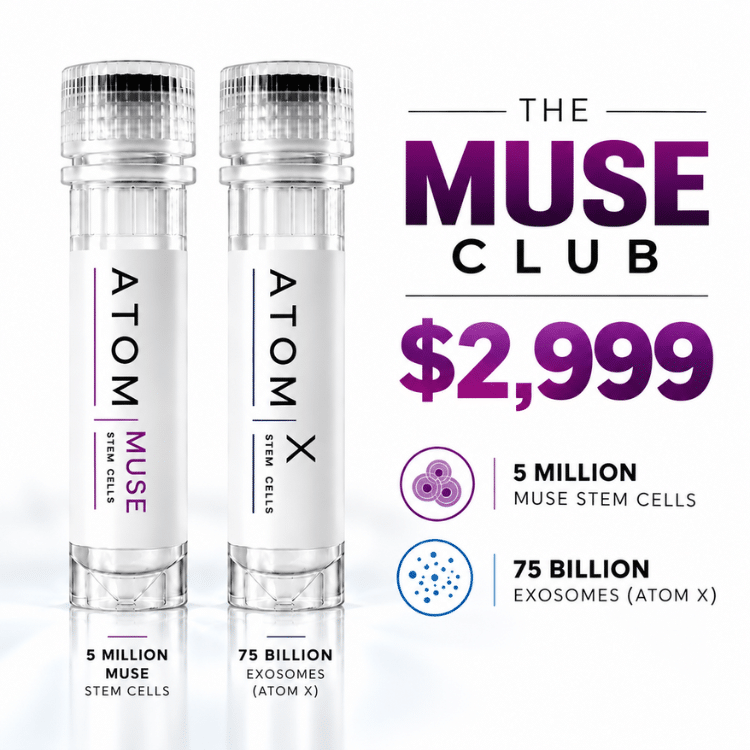
MUSE Stem Cells. Verified. $2,999.
Anyone can call a product "MUSE." You deserve proof. Every lot you receive comes with SSEA-3 marker confirmation, a Certificate of Analysis, and lab-verified post-thaw viability — documentation you're welcome to review before your appointment.
Book a free consultation to see if MUSE is a fit for you. We'll call within 24 hours — straight answers, no sales pressure.
No broker markups, no sales commissions. You'll know your price before you ever walk in.
Your info is private. No spam, no high-pressure sales — ever.
Clinical oversight by Dr. Joshua Batt, DO, Medical Director. Your appointment is administered by licensed clinical staff (NP or RN).
How you know it's real MUSE
"MUSE" is showing up on more clinic websites every month. Very few can prove it. Here's what stands behind every lot you receive.
SSEA-3 is the marker researchers use to identify MUSE cells. No SSEA-3 confirmation means you're likely getting standard stem cells with a new label.
Lab documentation tied to the exact lot you receive — not a generic spec sheet.
Measured after thawing, closer to the time of use — not just when the cells were frozen.
Ask to walk through the documentation during your free consultation.
Why people are asking about MUSE
MUSE (Multilineage-differentiating Stress-Enduring) cells are one of the most discussed areas of emerging stem cell research.
A rare, distinct cell type
MUSE cells are a small subpopulation naturally found in bone marrow, fat, and connective tissue. They were first identified in 2010 by researchers at Tohoku University in Japan.
Drawn toward stressed tissue
Published research suggests MUSE cells respond to distress signals released by damaged tissue and may migrate toward those areas.
An encouraging research profile
Preclinical and early clinical studies have reported a favorable safety profile. Research is still emerging, and your provider will be straight with you about what it does and doesn't show.
Why people choose us
Straight answers and upfront pricing — that's what members tell us made the difference.
"I called five clinics. The Stem Cell Club was the first to tell me the price upfront. No games, no 'come in first' — just clear, straight answers. That's what won me over."
"At 67, I was looking for a wellness option that fit my lifestyle and my budget. The team was straightforward, the appointment was easy, and I've made it part of my regular wellness routine."
These reflect personal experiences shared by individual members and are not guarantees of any specific outcome. Individual results vary — not typical. Stem cell offerings are not FDA-approved to diagnose, treat, cure, or prevent any disease.
Your MUSE questions, answered
What are MUSE cells?
MUSE cells are a naturally occurring stem cell subtype found in bone marrow, fat, and connective tissue. They're identified by a surface marker called SSEA-3, which sets them apart from standard mesenchymal stem cells (MSCs).
How do I know I'm getting real MUSE cells?
Every lot comes with SSEA-3 marker confirmation, a Certificate of Analysis, and lab-verified post-thaw viability. You're welcome to review that documentation during your free consultation — before you commit to anything.
How is MUSE different from your $1,999 option?
Our $1,999 option uses standard MSCs. The MUSE Club uses the SSEA-3-confirmed MUSE subpopulation. Your provider will help you understand which option fits your goals — no pressure either way.
What happens at the appointment?
Plan on 1–2 hours in the office, administered by licensed clinical staff (NP or RN). You go home the same day.
Is MUSE FDA-approved?
No. Stem cell offerings, including MUSE, are not FDA-approved to diagnose, treat, cure, or prevent any disease. We'll be honest with you about what current research does and doesn't show.
See if MUSE is right for you
Book your free consultation. We'll call within 24 hours, answer your questions, and show you the documentation — no pressure.